Shoot film? Get featured →
Analog Resurgence
← Guides

Buying guide: the basics

The camera

What is an SLR?

SLR stands for Single Lens Reflex. Light passes through the lens and is reflected by a mirror into the viewfinder: you see exactly what you photograph. SLRs are versatile, interchangeable (lenses), and offer excellent image quality. Ideal for learning manual photography.

Camera types

SLR (reflex): through-the-lens viewfinder, interchangeable lenses, ideal for learning. Point and shoot: all-in-one, lightweight, often automatic. Rangefinder: separate viewfinder, framing by image coincidence, precise and discreet. Medium format: 120 or 220, superior quality, bulkier.

Buying used gear

Check photos carefully: lenses, optics, overall condition. Prefer sellers with returns; ask if the light meter and shutter speeds work. On eBay, local marketplaces or MPB: read reviews; specialized shops (MPB, KEH) are often more reliable but slightly pricier.

Lens mounts

Canon FD: very common, affordable, great value. Nikon F: the most compatible (since 1959). Pentax K: same, widely available. Minolta MD/MC: often underrated optics. Olympus OM: compact and quality. Choosing a popular mount means more lenses and parts available.

Film

Film stocks: types and formats

C41: color negative, the most common. Standard lab development. BW: black and white, flexible development (you can do it yourself). ECN-2: cinema stock (Kodak Vision3), specific development (Cinestill, some labs). 24 or 36 exposures: 36 is more economical per shot. Half-frame: 72 photos on a 36-exposure roll, ideal for testing without breaking the bank.

ISO and sensitivity

ISO 100: bright sun, fine grain. ISO 400: versatile, indoor or outdoor. ISO 800+: low light, more noticeable grain. Sensitivity is fixed per roll: choose based on the light.

Choosing your film

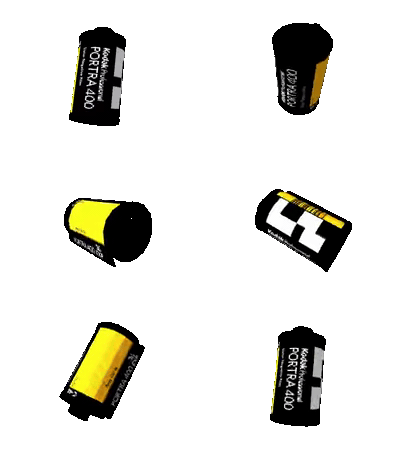
Portrait: Kodak Portra 400, soft skin tones. Landscape: Fuji Velvia (slide) or Ektar 100. Everyday: Kodak Gold 200, ColorPlus, Fuji C200. Black and white: Ilford HP5 (versatile), Tri-X (contrast). Beginner: Kodak Ultramax 400 or Fuji Superia 400, forgiving of overexposure.

Using your camera

Loading film

Open the back, pull the rewind knob to release the spool. Slide the film in, hook the leader to the take-up spool, close and advance until the counter shows 1. Check that the advance lever moves with each shot.

Exposure and modes

P, S, A, M modes

P (Program): camera picks shutter speed and aperture. S (Shutter): you set speed, camera sets aperture. A (Aperture): you set aperture (depth of field), camera sets speed. M (Manual): full manual, you control both based on the light meter.

Shutter speed

1/500: freeze motion. 1/125: everyday use. 1/60 and below: risk of camera shake, use a tripod or brace yourself. 1/30: handheld limit for most.

Aperture and depth of field

f/2.8 or wider: background blur, portraits. f/5.6: versatile. f/11 or narrower: everything sharp, landscapes. The smaller the number, the wider the aperture and shallower the depth of field.

The light meter

Measures light to suggest exposure. Center-weighted: measures the center. Matrix: analyzes the whole scene. Compensate if the subject is very bright or dark (+1 or -1 EV). Selenium cell meters age: verify with a smartphone app.

Focusing

How to focus

Manual (SLR): turn the ring until the subject is sharp in the viewfinder (split prism or microprism). Zone focus (compact): frame subject in center, half-press, recompose. Rangefinder: align the two images in the central patch. Hyperfocal: set to infinity for maximum depth of field.

Maintenance

Camera maintenance

Storage: dry place, away from humidity (fungus). Avoid extreme cold and heat. Cleaning: microfibre cloth for the body, blower for lenses. Never touch glass with fingers. Service: every 5–10 years or if speeds feel off. A pro will clean and re-lubricate the mechanism.

Buying used

Risks of buying used

Fungus: white spots or filaments in lenses, often irreversible. Check lens photos in backlight. Oil on blades: sticky aperture, repairable by a pro. Shutter: wrong or stuck speeds. Light meter: can be off. Dust in viewfinder: cosmetic. Always ask for detailed photos and prefer sellers who accept returns.